

Are you looking to build a fire table, or do you have questions about your existing fire feature? Look no further than your experts at EasyFirePits.com! We’ve got you covered on all of your fire feature concerns. So refer to our Q&A below, check out our catalog with more FAQs, or don’t hesitate to email us at info@EasyFirePits.com.
How far should my burner be from the table sides?
The answer depends on your type of burner. If you have a ring or square burner, it should be around 4-to-5 inches from the sides of the table. However, linear burners are fine with a minimum of 1-to-2 inches from the sides.
What size opening do I cut for my stainless steel insert/pan?
When cutting openings for stainless inserts/pans, we suggest at least an additional ¼ inch around in addition to the inside dimensions of your pan or insert. This allows room for slight variances as well as expansion and contraction.
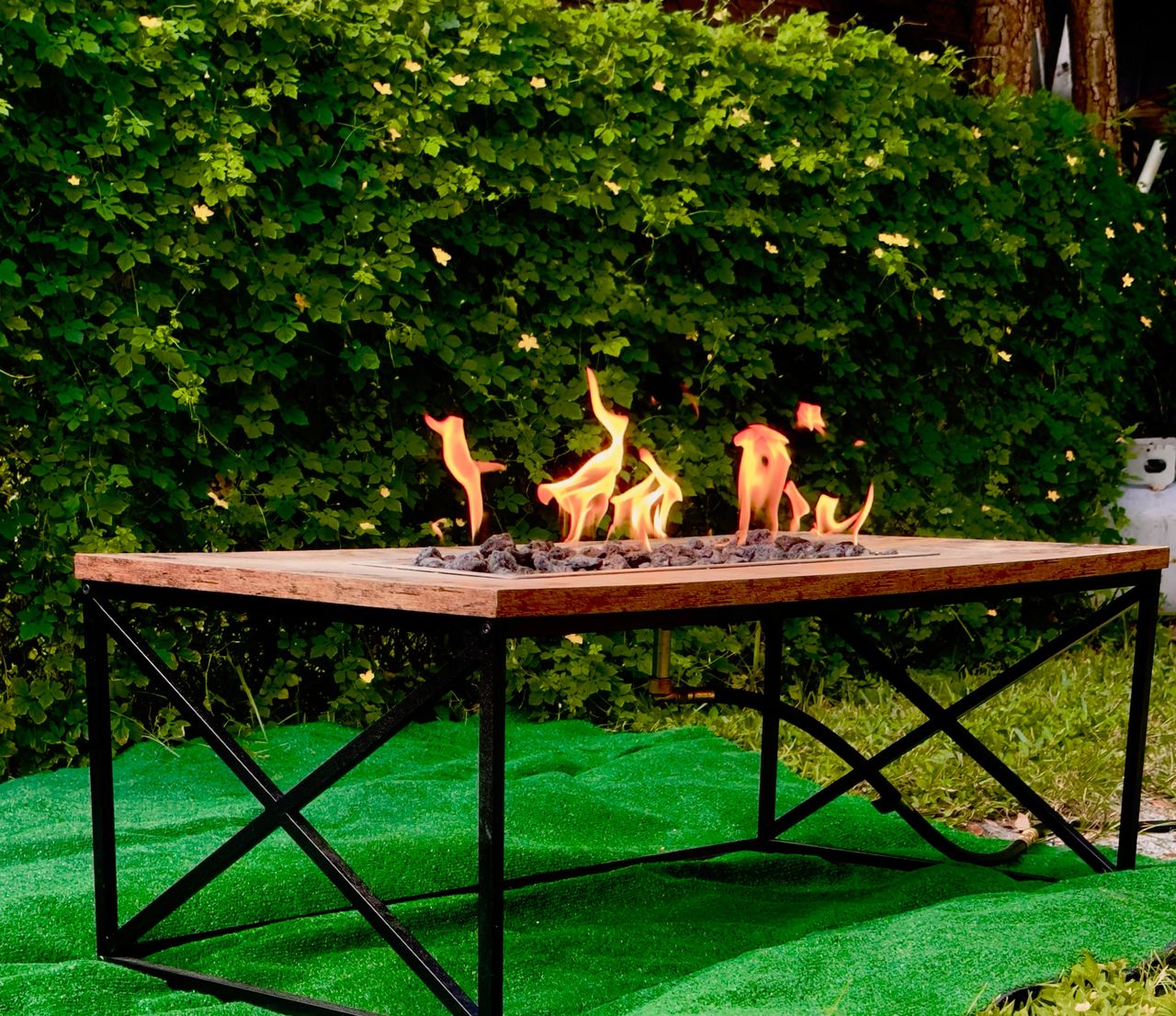
My fire table blows out from the wind? Do you sell screens or covers?
We offer high quality glass enclosures, wind guards, and wind shields for all of our rectangular burners. These are all custom-fitted to our accompanying pans and inserts. Take a look at our selection.
Why is my Pan/Insert bending up when heated?
Our stainless steel pans, and metals in general, experience expansion and contraction, which is why we encourage adding at least ¼ inch to the pan’s dimensions when making a cutout for your fire table or fire feature.
The best way to reduce the expansion effect is to reduce the heat to the pan, which can be accomplished by filling the bottom of the pan up to the burner with pea gravel. From there, you can add your fire glass or lava rocks on top, covering no more than ½ inch above the burner.
Can I mount an insert on a wooden table? Will it burn?
For wooden tables, we suggest adding a little more space between the burner and table when making your cutout. In general, ½ inch between the pan and the table should suffice. We also encourage using High Temperature Gasket Tape to reduce the risk of passing more heat to the wood.
It may be best to use a lower pressure regulator or make sure the needle valve on your regulator is throttled down so that you are not “cranking” your fire feature as the heat from the fire can still be intense.